Posts Tagged ‘Editing’

Dr. Simon McGuire

Over the past decade, something quietly transformative has been happening in the Mid-West of Ireland. Once considered peripheral to the Irish screen industry, Limerick is increasingly finding itself at the centre of major international film and television production. At the heart of this change is Troy Studios, Ireland’s largest purpose-built film and television production facility. Since opening in 2017, the studio has attracted large-scale international productions and helped establish the Mid-West as a serious player in global screen production, (limerick.ie) Recent developments signal that this growth is far from slowing down. A new multi-million euro partnership aims to transform Troy Studios into a global hub for unscripted television formats, with international productions expected to begin pilot projects from 2026 onwards. (limerick.ie)

These developments raise an important question for the region: If production is growing rapidly in Limerick, why is so much post-production still happening elsewhere?

Historically, Ireland’s post-production infrastructure has been concentrated in and around Dublin. Editing suites, sound mixing facilities, colour grading houses, and VFX studios have developed around the capital due to the clustering effect typical of creative industries. Examples of these would include; ScreenScene, Pirana Bar and Element Post to name but a few… not forgetting the recently closed Windmill Lane Post facility.

However, Limerick’s screen ecosystem is beginning to look different. Large productions have already demonstrated the region’s capability. Apple TV+’s Foundation, and Angel TV’s The Wayfinders for example, generated hundreds of jobs during their time at Troy Studios and signalled to international producers that the Mid-West could host high-end television drama. The production of series two of The Wayfinders is also returning this April for its second series. Alongside these productions, a skilled workforce is emerging. More than 350 locally-based crew now operate in the region, many with experience on international features and television series. Yet while cameras, sets, props, and production offices are increasingly located in Limerick, the editorial pipeline often moves elsewhere once filming wraps. The common feedback I receive about this is that ‘editors can be remote’, ‘media drives travel‘, ‘post workflows can travel‘… and with them, the economic and creative opportunities.

There is a case to be made for a Mid-West Post-Production House. Imagine a dedicated post-production facility located in Limerick city. Not simply a collection of editing rooms, but a full post-production ecosystem designed to support regional productions from offline edit through to delivery.

Such a facility could include:

  • Offline editing suites (Avid / Premiere / Resolve)
  • Shared storage and media management infrastructure
  • Colour grading theatre
  • Audio post-production and ADR facilities
  • VFX and motion graphics workspaces
  • Remote collaboration capabilities for international productions

This could fundamentally change the regional production pipeline. Instead of productions filming in Limerick and finishing in Dublin or London or further afield, projects could remain in the Mid-West for the entire creative lifecycle. This would in affect also benefit a talent pipeline that already exists in the region and strenghtening the argument of targeted education and training. Across Ireland, and particularly in the Mid-West, increasing numbers of students are studying film, television production, and post-production at third-level institutions such as LSAD, TUS, Mary Immaculate College UL and the Educational Training Board FETs. A number of these students specialising in editing, sound, and digital storytelling. Yet a recurring challenge emerges after graduation of gaining a foot in the door for crafts such as editing and post-production. There are very little opportunities for graduates outside of Dublin to build their careers and with the ever increasing cost of living in the capital city, where most jobs exist in this sector, the pressure to relocate to the capital or leave the industry is a real problem before these graduates even begin. A post-production house in Limerick could help retain this talent locally while strengthening the regional creative economy.

There are some economic ripple effects in this concept. Film production has already demonstrated its economic impact on the Mid-West. A single feature production can involve more than 90 local businesses, from hotels to construction suppliers. (Limerick’s Live 95) And a new Post-production eco-system could extend this economic footprint. Unlike location shooting, post-production can last months rather than weeks, bringing sustained employment to editors, assistant editors, sound designers, colourists, and technical operators. It also attracts a different type of creative professional, one who may settle in a city long-term rather than arriving temporarily for a shoot. This could contribute to the emergence of a permanent screen industry cluster in the Mid-West.

Ireland’s screen industry has long benefited from regional diversity of locations. But the next phase of growth may depend on regional diversity of infrastructure. Dublin will remain a critical centre for the industry, but if the Mid-West is to fully realise the potential created by Troy Studios and the growing local crew base, the region must also invest in the stages after the cameras stop rolling. Editing is where stories truly take shape. And perhaps the next chapter of Ireland’s post-production story could be written in Limerick.

There are some questions that may be worth asking if a post-production house in the Mid-West is possible:

  • Could a regional post-production facility operate sustainably outside Dublin?
  • What scale of investment would be required to establish a viable editing and finishing house?
  • Could partnerships between industry, local authorities, and third-level institutions make such a project feasible?
  • How might a facility integrate with the production activity at Troy Studios?
  • Could this create a regional training pathway from student to assistant editor to editor?
  • Might international productions be encouraged to complete post in Limerick if the infrastructure existed?
  • Could shared facilities reduce barriers for independent filmmakers in the region?
  • And most importantly: who might take the first step in making it happen?

The growth of screen production in the Mid-West suggests that the opportunity is real. The question now is whether the region is ready to edit its own future.
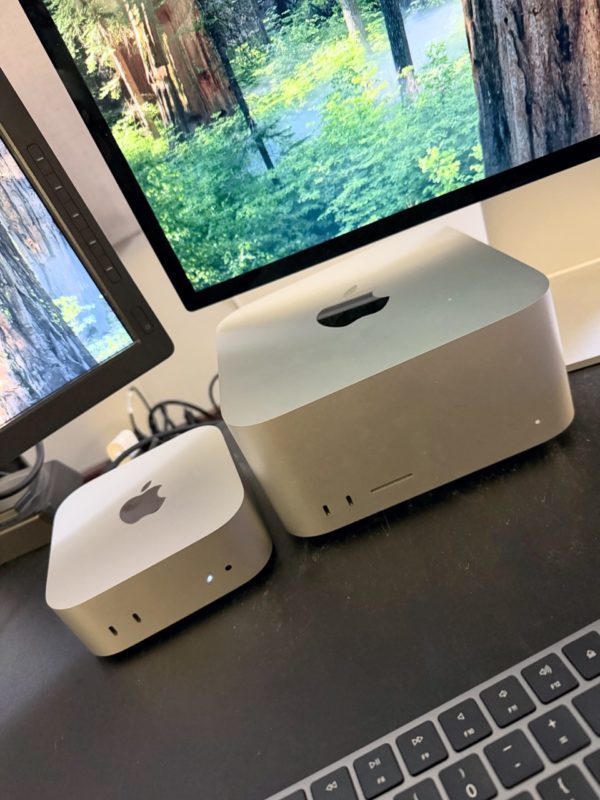
A number of my students recently enquired about my opinion on buying a new mac for video editing. They were confused about the silicon choice (M1 to M4 and probably let’s face it… M5 down the road) as well as the best graphic and RAM option. As I use Avid Media Composer, Da Vinci Resolve, and at times Adobe Creative Suite, I realised that the students had a point about the many choices.

Upon checking a few sites the following article came across my browser and it does a good job in answering some of the students questions as well as a few of my own. Having an ageing 27” 5K iMac myself, I will be looking closely on the options available for a future investment, and the advise in this article by Jeff Greenberg will help in my and hopefully the students decision.

Click on the link HERE or on the image above.

As the Irish Film Festival circuit gains momentum, and the weather is holding, film makers around the country are racing to complete production on their short films. This is where CRAFT and help. With several short films completed and gone on to win awards around he country and abroad, we are eager to work with filmmakers from not just the Mid-West but further afield.
We have the gear, software and most importantly knowledge and experience to deliver your story to the highest standards.
Also we can come to you, as we also have a mobile edit kit.

Check our CRAFT HERE

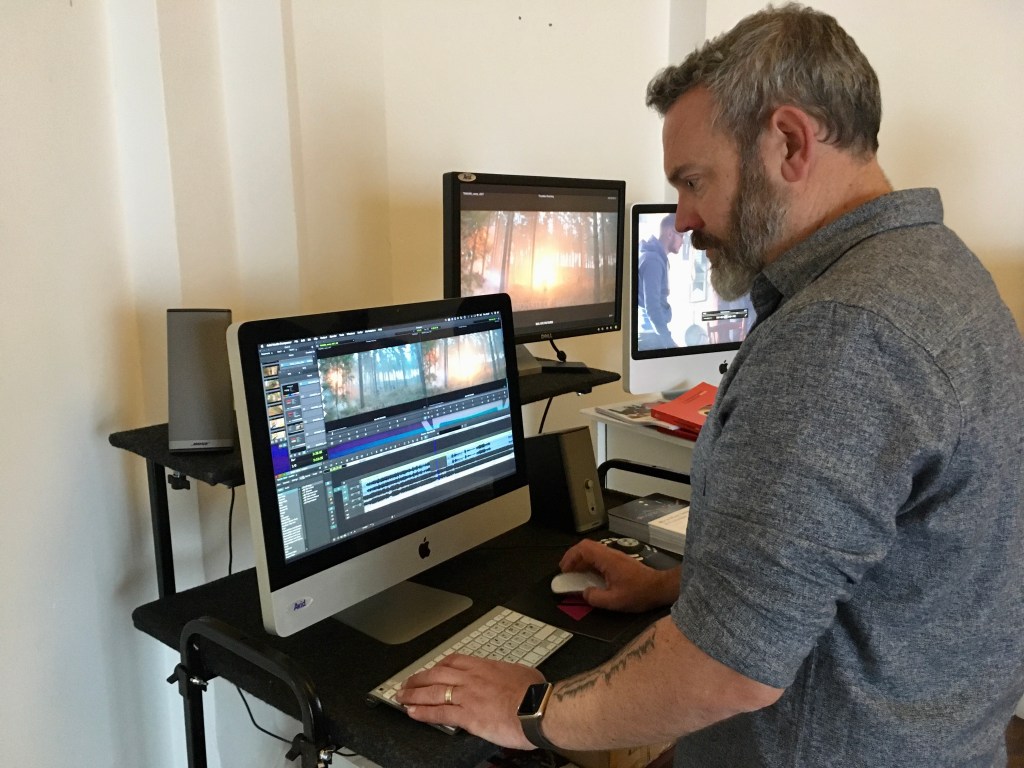
Film Post Production Editor / Lecturer Simon McGuire at the 2019 LSAD open day demonstrating trailer editing.

Our TUS campus open days are an ideal opportunity for you, your friends and family to join us on campus and find out first-hand what it is really like to be a student at TUS and if you are thinking about a career in the Film, Broadcast or Music Industries then why not check out the LSAD Open Day on November 27th from 10 – 2pm on the Moylish Campus.

There will be representatives from the academic staff as well as current students to chat to you about our programmes:

Creative Broadcast & Film Production

Music Technology & Production

For more info and registering for this event check out HERE or click on the photo above.

Click on image to goto the link to register.

 ‘To cut a long story short’,

Online workshop for aspiring film editors hosted by Film in Limerick 

Free online workshop will explore the art of editing and career opportunities in the field 

Media Release Thursday 7 May 2020 

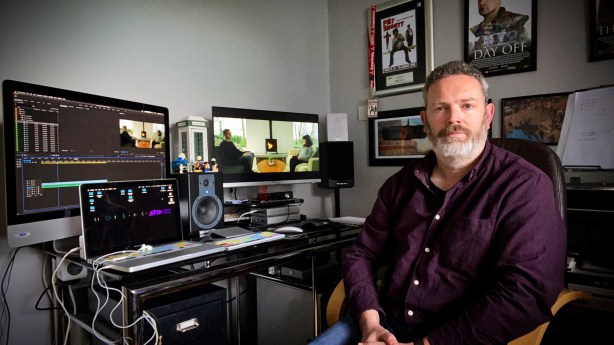
Simon at his edit suite.

Innovate Limerick through Film in Limerick is delighted to announce that local film editor Simon McGuire, will join us Wednesday 6 May at 2pm for a free online webinar on working as a film editor. 

The workshop is the latest in the Wednesday Workshops series and is open to anyone in the Mid-West with an interest in filmmaking. 

With over twenty five years’ experience in film and broadcast editing, with credits including; RTÉ’s Killinaskully, Mattie and Kevin Liddy’s, The Suffering Kind. Simon lectures on the craft of editing at Limerick School of Art & Design (LIT), and is currently undertaking a Doctorate of Education in Creative Media Practice at Bournemouth University, UK. 

The workshop, titled ‘To cut a long story short’, will explore Simon’s process and the craft of editing as well as the tools he uses to create stories. The session will also focus on work opportunities in Ireland and further training possibilities for aspiring and developing editors. 

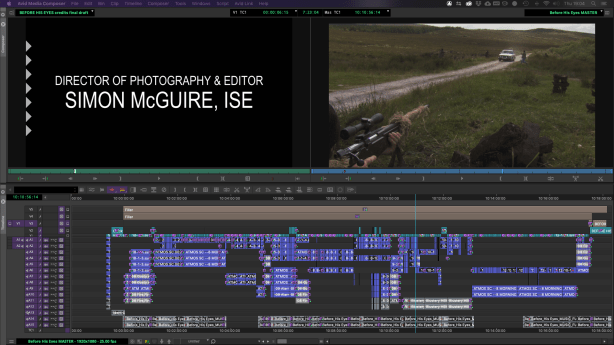
Editing time line for the short film ‘Before His Eyes’ (2020). Director, Paul Boyle.

Regional Film Manager, Paul C. Ryan, says: “we are thrilled that Simon will be joining us for what promises to be a really useful workshop for anyone aspiring to develop a career as a full-time editor in Ireland. Simon is one of our most talented editors and a great champion for film students in the region. 

The workshop is the fifth of 10 free online ‘Wednesday Workshop’ events that 

Film in Limerick is running for aspiring and practicing filmmakers in the MidWest. The initiative is supported by Limerick and Clare Education and Training Board. 

Register for the event here 

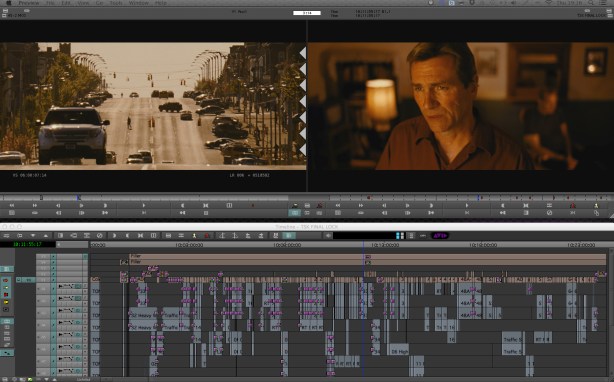
Editing timeline for ‘The Suffering Kind’ Director, Kevin Liddy

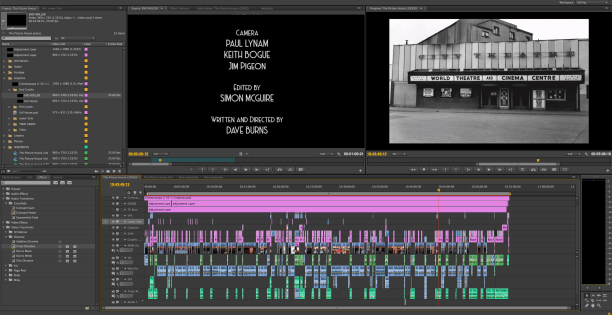
Editing Timeline for the Limerick documentary. ‘The Picture House’

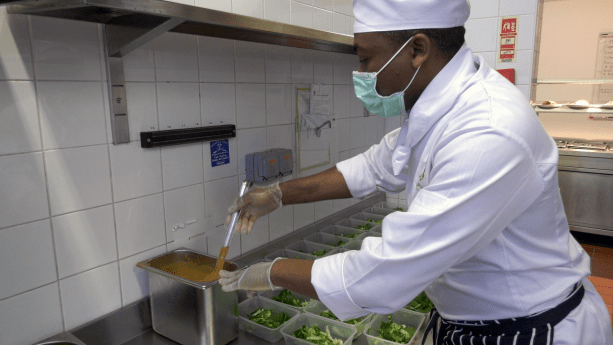
Had the pleasure of filming and editing this package for the Hospitality Training & Education Centre, where some of the shots featured on the RTÉ programme, “Ireland On Call’ on Tuesday 21st April.

The package highlights the fantastic work by the centre with the Volunteer learners, who are providing high quality meals for the front line workers across the mid-west.

Press Release (in part)

The operation has also seen significant support from businesses in the region and beyond. Bernadette says: “The support we have gotten has been fantastic. Irema Ireland in Kilmallock supplied the face masks for all our food production and delivery staff. Delivery containers were supplied by Noel O’Connor of Pat O’Connor Butchers, along with plastic crates from Richardson’s Foods and wooden trays from Pat The Baker. Paul Cross Sharpening Services, based in Rathangan, County Kildare, provided uniforms and protective clothing for deliveries. And, Pallas Foods even provided us with Easter eggs for all the food deliveries going out over the Easter weekend!”


Responding to the launch of the new initiative, Bedelia Collins, COVID-19 Co-ordinator of Resources and Service Offers, HSE Mid West Community Healthcare, says the service is very welcome: “Bernadette and her team have been so professional and so easy to work with, which is just what’s needed at the moment. The flexibility that’s been offered with the service is great, especially with the transporting of meals to the different locations in the region. Staff are really touched and very grateful. They are delighted with the quality of food. We started with almost 100 meals on Thursday and expect this to increase significantly in the coming days.”

For further Information contact:
Bernadette Enright, Manager, Hospitality Education and Training Centre,
Limerick and Clare Education and Training Board
Telephone: 085 242 1819 | Email: bernadette.enright@lcetb.ie


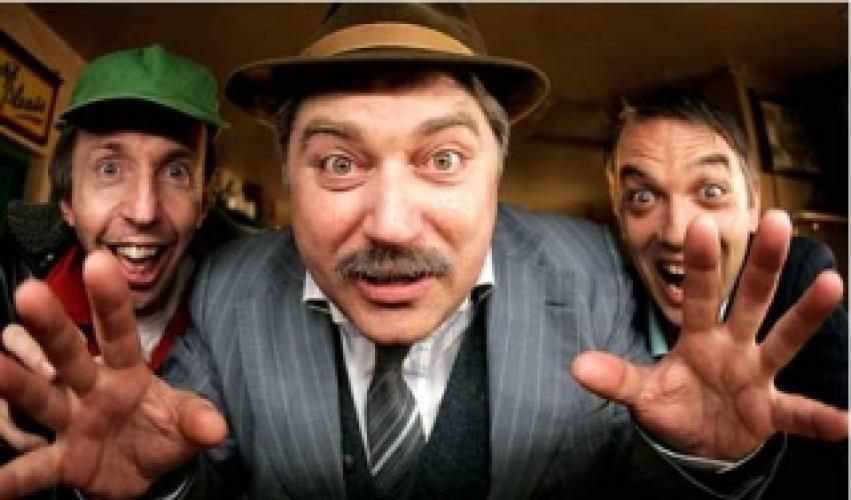
Jimmy (Jack Walsh), Dan (Pat Shortt) and Timmy (Joe Rooney)

Killinaskully is to be aired again on RTÉ One, starting this weekend on Sunday 19th at 8pm, with the pilot episode from series one.

This was a great time of my career working with the cast and crew as Assistant Editor and then Editor on the later episodes.

Something to look forward to during the lockdown.

More Info soon.


Hi all

Following yesterdays post, here is the new documentary by Jon Lefkovitz;

Sight & Sound: The Cinema of Walter Murch.

or watch it here:

SIGHT & SOUND: The Cinema of Walter Murch from Jon Lefkovitz on Vimeo.


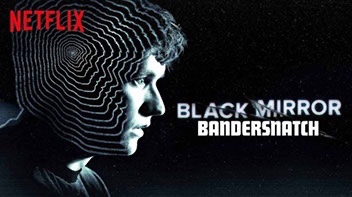
Hosted by The Irish Screen Editors Guild (ISE) and the team at Element Post, ISE members were treated to Editor Tony Kearns’ presentation of his contribution to the Emmy winning Black Mirror interactive film Bandersnatch.

Detailing the challenges involved in a complex interactive narrative and the resulting workflow, Tony described how he and his team worked with the multiple timelines needed to maintain the different choices the user can make on the meta narrative.

If you are also interested in Tony’s previous work then check out some examples of his editing on music videos below:

RadioHead – Just

Chemical Brothers – Believe

And if you haven’t experienced Black Mirror Bandersnatch, then log into Netflix on your smart device or smart TV.

IMDb page HERE

ISE Blog Post By Mark Gilleece on the Masterclass.

Tutors: Eoin McDonagh, Editor
Date: Friday, January 24th, 2020
Duration: 1 Day
Venue: Dublin TBC
Cost: €150

Course Profile:

In this course participants will gain a full insight into the role and responsibilities of the assistant editor.

Areas covered include:

  • Organising project and footage
  • The difference between fiction and non-fiction assisting
  • Expectations of performance from the assistant editor

Preparation

  • Ingest of rushes
  • Logging and synching
  • Treatment of non-standard archive

Editing

  • Sound work – Track laying on sequences
  • Adding Footage as the edit continues – Moving footage between machines – Importance of Master project
  • Preparation of exports/promo material – Choice of codecs for export – Using third party compression software – BITC

Finishing

  • Relinking to full-res – Project parameters (SD, HD,2k etc.) – How to check the relink is correct – Troubleshooting relink problems
  • Creation of deliverables for Grade and Mix

Participant Profile:

This one-day course is aimed at those interested in moving into assistant editing and who wish to gain a thorough overview of the role and the responsibilities it entails. Applicants should have a working knowledge of Avid Media Composer and/or Adobe Premiere and/or FCPX. There will be a one-day supervised placement with an editor working in non-fiction offered to those interested.

Application Procedure:

Please apply online at www.screenskillsireland.ie by 12:00 PM, Tuesday, January 7, 2020, attaching a current CV and an overview of why you would like to participate  in this course.

You need to be logged in or registered to apply for a course. Click here Login/Register