Archive for the ‘Education’ Category

Dr Simon McGuire

The landscape of higher education in Ireland, and particularly within the creative sectors of film and television, is undergoing a profound recalibration. As educators, we find ourselves navigating a convergence of technological acceleration, infrastructural constraint, and shifting economic and cultural realities. Yet within this turbulence lies an opportunity: to rethink not just how we teach, but what it means to prepare students for a screen industry that is itself in a constant state of flux.

With a sector that is expanding faster than its classrooms, Ireland’s audiovisual industries are thriving. Recent data highlights employment of nearly 16,000 people and significant economic contribution, underlining the industry’s vitality and global relevance (Screen Ireland Link). Alongside this, reports on immersive technologies and virtual production point toward a future defined by real-time rendering, AI-assisted workflows, and cross-platform storytelling (Skillnet Ireland Link). However, Higher Education has not expanded at the same pace. Institutions are expected to deliver industry-ready graduates while contending with ageing facilities, limited access to high-end equipment, and increasing student numbers. This mismatch between industry expectation and educational capacity is becoming one of the defining tensions in Irish creative education and I am sure is a talking point in this week’s teaching union meetings across the country.

There is a material reality also with the financial constraints being well documented. A widely cited government report showed a funding gap of over €300 million annually in Irish higher education, a deficit that continues to shape institutional decision-making (The Irish Times Link). While the report is three years old now, this underfunding still exists and I would argue that the figure is far greater and manifests itself in tangible ways such as: insufficient studio space, outdated post-production labs, and limited access to industry-standard tools such as camera, lighting and sound equipment. At the same time, the cost of keeping competitive film and television programmes is rising. Cameras, lighting rigs, editing suites, and now virtual production environments require continuous and not just the initial capital investment. Yet universities increasingly rely on hybrid funding models, including in some cases industry partnerships, which can risk narrowing the scope of academic inquiry toward commercially workable outputs (Public Policy Link).

Space is another critical pressure point. Reports on Higher Education infrastructure note that institutions are being forced to rethink how physical environments are used, with flexible and multi-purpose spaces becoming essential (Savills Link) For film and television education, traditionally reliant on dedicated studios, this presents both a challenge and a creative constraint. The most significant shift is technological. The integration of AI into editing workflows, the rise of cloud-based collaboration, and the emergence of virtual production are fundamentally altering the grammar of screen production. These are not incremental changes; they redefine authorship, labour, and craft.

Irish higher education has already begun adapting. Quality reports highlight increased digitalisation of teaching, learning, and assessment, alongside hybrid and remote workflows (Quality and Qualifications Ireland Link). However, there is still a gap between adopting digital tools and embedding them meaningfully into pedagogical or andragogical practice. The challenge is not simply access to technology, but developing critical, reflective practitioners who can navigate and question these tools. Considering these pressures, I propose three practical, scalable responses that can be implemented across Irish Higher Education.

Firstly, a distributed studio model.

Rather than centralising production within a single campus facility, institutions should adopt a distributed model of practice. This would involve:

  • Leveraging community media hubs and regional partnerships
  • Embedding production activity in real-world contexts
  • And if possible, sharing resources across institutions and sectors

In my doctoral research, I suggested an in-house production (IPU) unit to bring teaching and learning of craftsmanship together with industry engagent. I create one such IPU at my institution in the form of Film Cel (Film Craftsmanship, Excellence and Learning) (Link) at my institution, LSAD, TUS, and I believe that an IPU like this could bring together the the three elements above together for the distributed model of practice. National policy already points in this direction. The Future of Media Commission recommends the development of shared media hubs and collaborative training infrastructures to support talent pipelines (RTE Link). For educators, this model would not only alleviate space constraints but situate learning within authentic production ecosystems.

A second approach would be to look at curriculum as a workflow and not a module.

Traditional module-based teaching structures are increasingly misaligned with industry practice. Instead, curricula could be restructured around workflows such as:

  • Development → production → post-production → distribution
  • Cross-disciplinary collaboration (editing, sound, VFX, producing)
  • Integration of AI and virtual tools as part of process, not add-ons

This approach would reflect the realities of contemporary screen industries, where roles are fluid and pipelines are interconnected. It also aligns with broader Higher Education trends toward flexible or hybrid learning environments (Royal Irish Academy Link).

Finally, there is an opportunity for industry embedded learning, but with safeguards for the institution, staff, and students. Partnerships with industry are essential but must be carefully structured. Institutions should:

  • Co-design projects with industry partners
  • Embed internships, mentorships, and live briefs into programmes
  • Maintain academic independence and critical inquiry

While private sector funding can provide vital resources, it also raises concerns about the commercialisation of education (Public Policy Link). The goal, therefore, is balance: enabling access to industry without compromising the broader educational mission.

So, with these three suggestions we could take the future of teaching film and television in Ireland from constraint to creative. The teaching and learning would not be defined by the resources we lack, but by how we respond to those limitations. Financial pressures, spatial constraints, and technological disruption are not temporary obstacles, they are the conditions within which contemporary education must operate. As educators, our role is to transform these constraints into pedagogical or even andragogical innovation. To move from the idea of the university as a site of instruction to a site of production, collaboration, and experimentation.

If we can achieve this, we will not simply keep pace with the industry, we will help shape its future.

Dr. Simon McGuire

Over the past decade, something quietly transformative has been happening in the Mid-West of Ireland. Once considered peripheral to the Irish screen industry, Limerick is increasingly finding itself at the centre of major international film and television production. At the heart of this change is Troy Studios, Ireland’s largest purpose-built film and television production facility. Since opening in 2017, the studio has attracted large-scale international productions and helped establish the Mid-West as a serious player in global screen production, (limerick.ie) Recent developments signal that this growth is far from slowing down. A new multi-million euro partnership aims to transform Troy Studios into a global hub for unscripted television formats, with international productions expected to begin pilot projects from 2026 onwards. (limerick.ie)

These developments raise an important question for the region: If production is growing rapidly in Limerick, why is so much post-production still happening elsewhere?

Historically, Ireland’s post-production infrastructure has been concentrated in and around Dublin. Editing suites, sound mixing facilities, colour grading houses, and VFX studios have developed around the capital due to the clustering effect typical of creative industries. Examples of these would include; ScreenScene, Pirana Bar and Element Post to name but a few… not forgetting the recently closed Windmill Lane Post facility.

However, Limerick’s screen ecosystem is beginning to look different. Large productions have already demonstrated the region’s capability. Apple TV+’s Foundation, and Angel TV’s The Wayfinders for example, generated hundreds of jobs during their time at Troy Studios and signalled to international producers that the Mid-West could host high-end television drama. The production of series two of The Wayfinders is also returning this April for its second series. Alongside these productions, a skilled workforce is emerging. More than 350 locally-based crew now operate in the region, many with experience on international features and television series. Yet while cameras, sets, props, and production offices are increasingly located in Limerick, the editorial pipeline often moves elsewhere once filming wraps. The common feedback I receive about this is that ‘editors can be remote’, ‘media drives travel‘, ‘post workflows can travel‘… and with them, the economic and creative opportunities.

There is a case to be made for a Mid-West Post-Production House. Imagine a dedicated post-production facility located in Limerick city. Not simply a collection of editing rooms, but a full post-production ecosystem designed to support regional productions from offline edit through to delivery.

Such a facility could include:

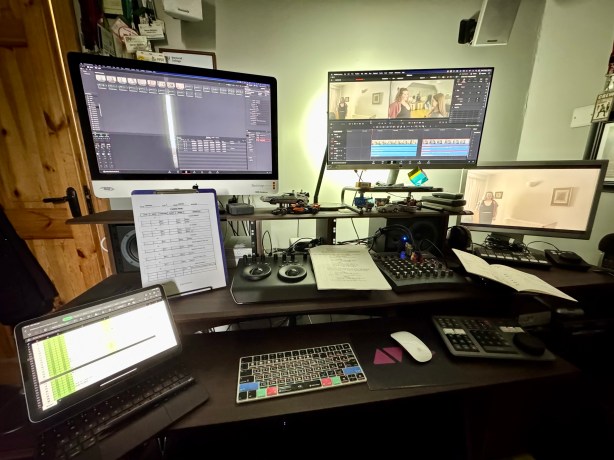
  • Offline editing suites (Avid / Premiere / Resolve)
  • Shared storage and media management infrastructure
  • Colour grading theatre
  • Audio post-production and ADR facilities
  • VFX and motion graphics workspaces
  • Remote collaboration capabilities for international productions

This could fundamentally change the regional production pipeline. Instead of productions filming in Limerick and finishing in Dublin or London or further afield, projects could remain in the Mid-West for the entire creative lifecycle. This would in affect also benefit a talent pipeline that already exists in the region and strenghtening the argument of targeted education and training. Across Ireland, and particularly in the Mid-West, increasing numbers of students are studying film, television production, and post-production at third-level institutions such as LSAD, TUS, Mary Immaculate College UL and the Educational Training Board FETs. A number of these students specialising in editing, sound, and digital storytelling. Yet a recurring challenge emerges after graduation of gaining a foot in the door for crafts such as editing and post-production. There are very little opportunities for graduates outside of Dublin to build their careers and with the ever increasing cost of living in the capital city, where most jobs exist in this sector, the pressure to relocate to the capital or leave the industry is a real problem before these graduates even begin. A post-production house in Limerick could help retain this talent locally while strengthening the regional creative economy.

There are some economic ripple effects in this concept. Film production has already demonstrated its economic impact on the Mid-West. A single feature production can involve more than 90 local businesses, from hotels to construction suppliers. (Limerick’s Live 95) And a new Post-production eco-system could extend this economic footprint. Unlike location shooting, post-production can last months rather than weeks, bringing sustained employment to editors, assistant editors, sound designers, colourists, and technical operators. It also attracts a different type of creative professional, one who may settle in a city long-term rather than arriving temporarily for a shoot. This could contribute to the emergence of a permanent screen industry cluster in the Mid-West.

Ireland’s screen industry has long benefited from regional diversity of locations. But the next phase of growth may depend on regional diversity of infrastructure. Dublin will remain a critical centre for the industry, but if the Mid-West is to fully realise the potential created by Troy Studios and the growing local crew base, the region must also invest in the stages after the cameras stop rolling. Editing is where stories truly take shape. And perhaps the next chapter of Ireland’s post-production story could be written in Limerick.

There are some questions that may be worth asking if a post-production house in the Mid-West is possible:

  • Could a regional post-production facility operate sustainably outside Dublin?
  • What scale of investment would be required to establish a viable editing and finishing house?
  • Could partnerships between industry, local authorities, and third-level institutions make such a project feasible?
  • How might a facility integrate with the production activity at Troy Studios?
  • Could this create a regional training pathway from student to assistant editor to editor?
  • Might international productions be encouraged to complete post in Limerick if the infrastructure existed?
  • Could shared facilities reduce barriers for independent filmmakers in the region?
  • And most importantly: who might take the first step in making it happen?

The growth of screen production in the Mid-West suggests that the opportunity is real. The question now is whether the region is ready to edit its own future.

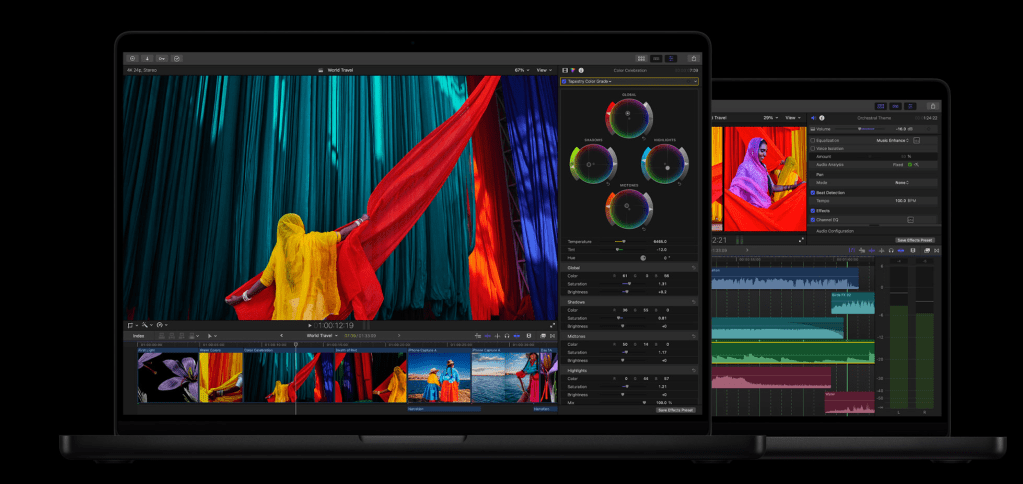
Apple have finally released their much anticipated ‘Apple Creator Studio’ which has raised a few eyebrows.

The apps you need for everything you want to create. Craft your stories with video in Final Cut Pro. Reimagine images in Pixelmator Pro. Produce your best music in Logic Pro. Supercharge productivity with premium content in Keynote, Pages, Numbers, and Freeform. Boost workflows with AI features that build on Apple Intelligence. And with Family Sharing, up to five other people can enjoy your subscription too.

With a price tag for a new subscriber at $12.99 per month or $129 per year after your free trial, it is yet another entry to the area of the market that Adobe Creative Suite has dominated for some time. With the DaVinci Resolve Studio package still retailing at the €313.65 (inc: VAT) for a licence (however Black Magic have also hinted recently at a subscription based option for their software package) this is a competaive option from Apple.

It remains to be seen if Apple and its Final Cut Pro NLE can regain some editing fans, but in the meantime it might be worth checking out the new suite of software apps on a new M4 chip Mac mini or studio.

Check out the details HERE

This is episode 2 of series 9 of Word On the Street, a production by Film CEL. LSAD’s in-house production unit.

Screenshot

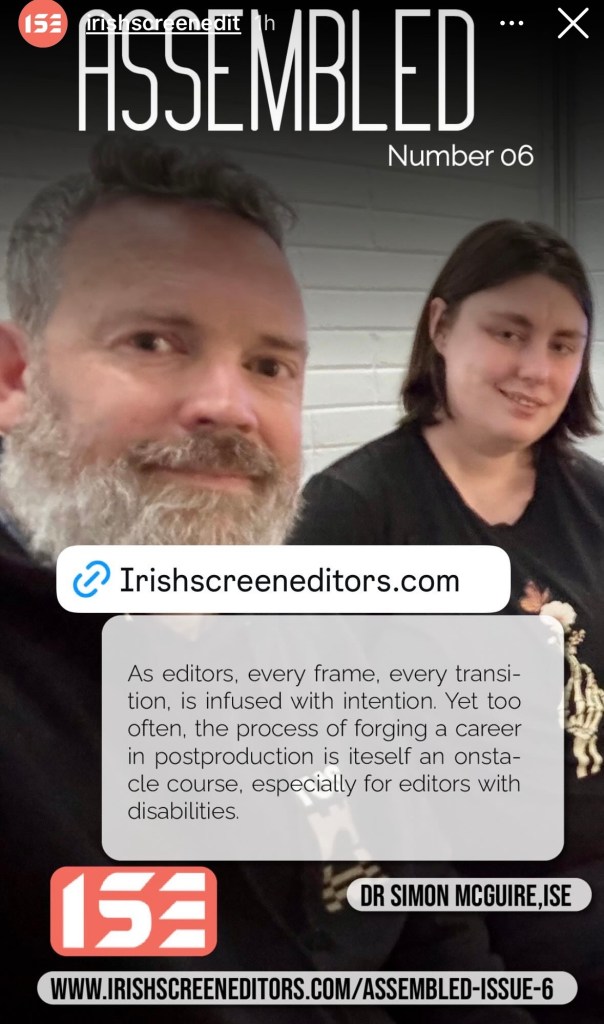
I had the opportunity to write an article for the latest edition of the Assembled Magazine for the Irish Screen Editors Guild (ISE), about the challenges people with disabilities face when entering the post production industry. A recent graduate of mine from the Creative Broadcast & Film Production programme, Katie Quirke, also gave me a direct insight to the challenges and how things can be improved for editors with disabilities. This article and many others are now available to read from the ISE website HERE or by clicking the image above. Special thanks to Katie for allowing me to tell some of her story and to Shane Woods ISE for asking me to contribute to this issue.

This episode features the new building at the Moylish Campus and the EUNIC Film Festival at the Millennium Theatre. Word On The Street is a non-for-profit news programme, produced by Film CEL, the in-house production unit, consisting of students and staff members of Limerick School of Art and Design TUS. Opening theme track: Ampyx & SANDR – New Colors

Limerick School of Art and Design TUS.

A short montage video highlighting a number of features of the LSAD Graduate Show 2025, including the special commissioned portrait by lecturer and artist Ken Coleman to the outgoing Dean of LSAD, Mike Fitzpatrick. Produced by Film CEL, LSAD’s in-house production unit. filmcel@tus.ie

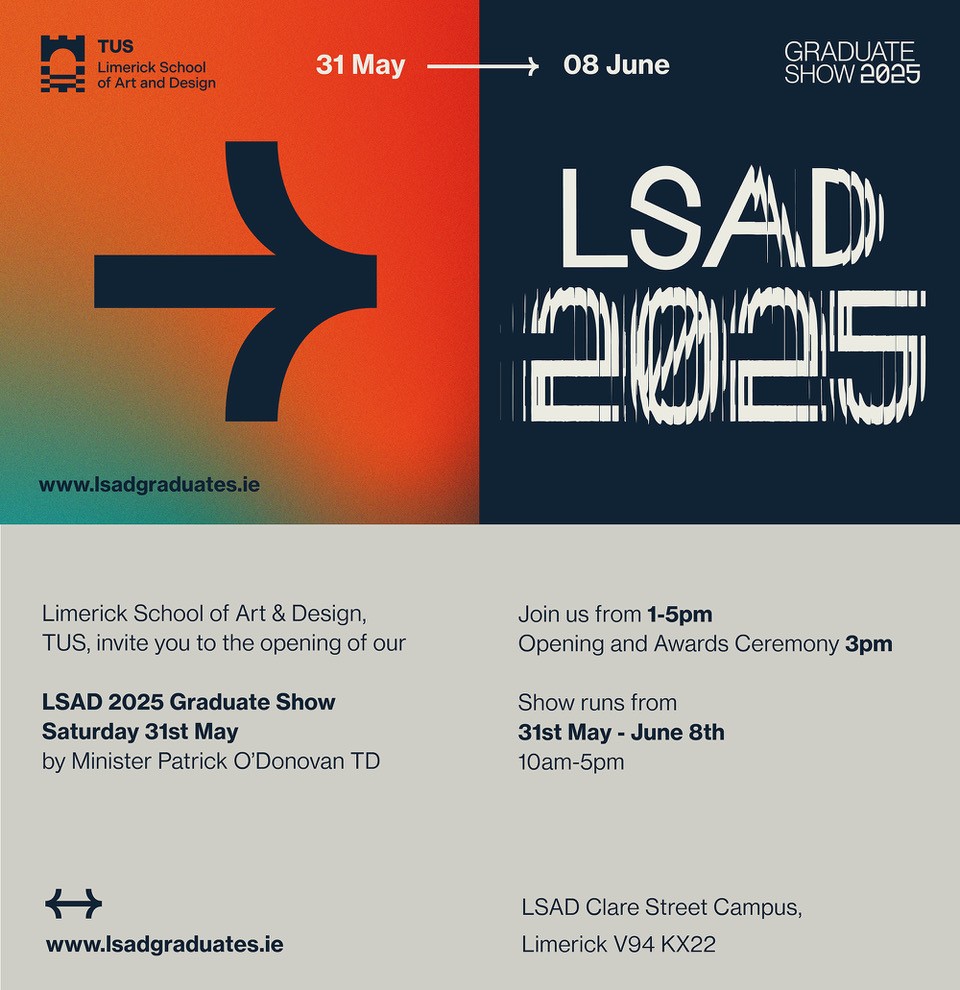
LSAD 2025 Graduate Show

Posted: May 20, 2025 in Education, live Event

This years LSAD Graduate Show will take place between May 31st and June 8th.
Watch this space for more information or click on the picture to go to the website.

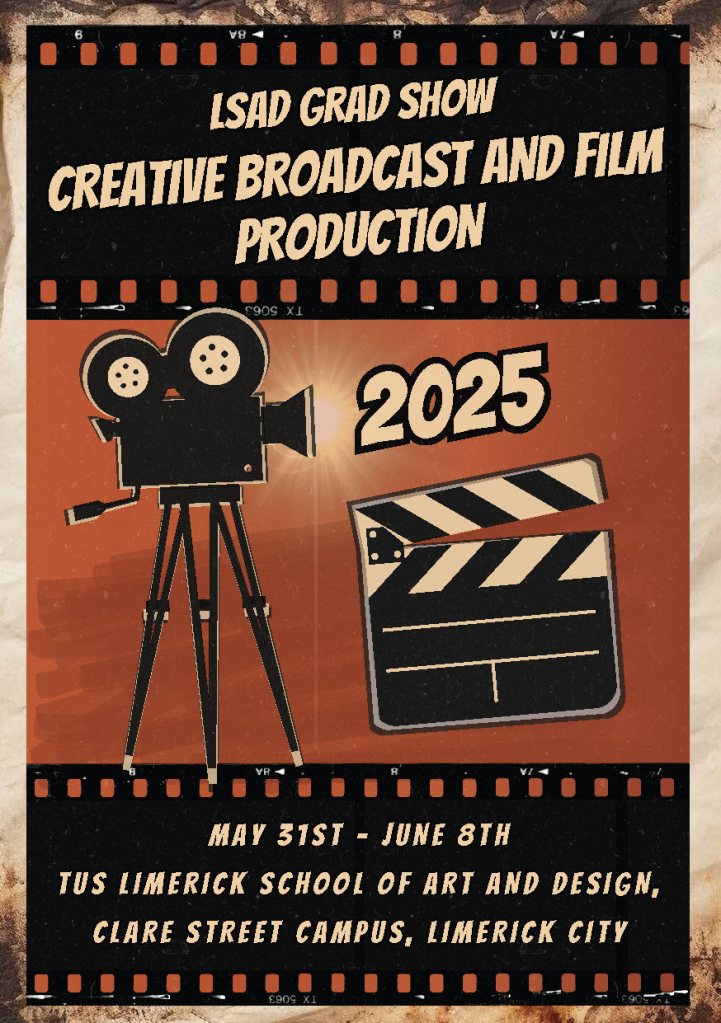
Taking place at the annual LSAD Graduation show at the Clare Street Campus, Limerick, will be the screening of end of year capstone projects from the 4th year Creative Broadcast & Film Production students.

There will be a series of short films, documentaries, portfolios and dissertations available to the public in a selected location in the campus, where the students themselves will also be in attendance to chat about their work and hopefully network too with visitors and even interested industry parties.

Why not come along to this event which is open from May 31st to June 8th 2025.

This highlights reel features a selection of content and programmes that were created by the 2025 crew of Film CEL. This years crew excelled themselves on all productions and projects, gaining experience on planning, camera operation, grip and rigging, lighting and sound and post production using Avid Media Composer.

This crew will continue as students in the year 4 of the Creative Broadcast and Film Production programme at LSAD, TUS where they will take these skills and develop new content and creative works for their final year.

Music track: Tell Me by Burgundy Source: https://freetouse.com/music Copyright Free Music for Video

Film CEL is an in-house production unit for the Creative Broadcast & Film Production Programme at LSAD, TUS.