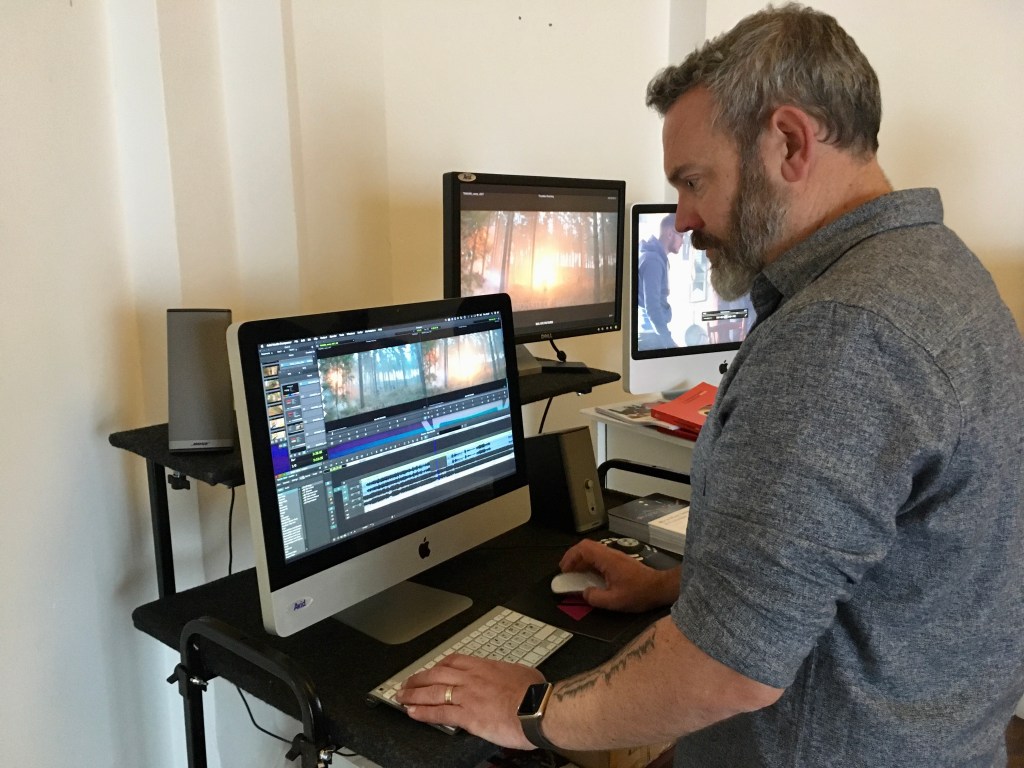
Film Post Production Editor / Lecturer Simon McGuire at the 2019 LSAD open day demonstrating trailer editing.
Our TUS campus open days are an ideal opportunity for you, your friends and family to join us on campus and find out first-hand what it is really like to be a student at TUS and if you are thinking about a career in the Film, Broadcast or Music Industries then why not check out the LSAD Open Day on November 27th from 10 – 2pm on the Moylish Campus.
There will be representatives from the academic staff as well as current students to chat to you about our programmes:
Released on October 30th, will be the brand new online programme, Pat Shortt’s Comedy Heads.
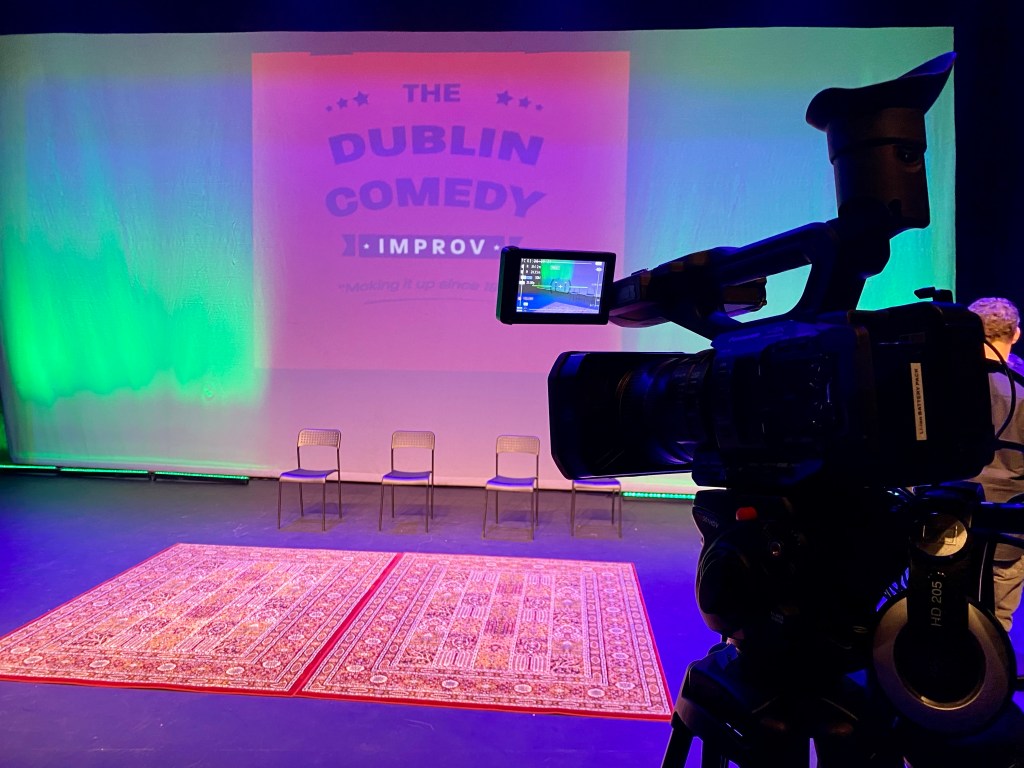
Produced by Short Comedy Theatre Company and Funded by Department of Tourism, Culture, Arts, Gaeltacht, Sport and Media, Pat Shortt has collaborated with Joe Rooney and The Dublin Comedy Improv Club to create an evening of comedy sketches and general madness.
Filming took place in the Moat Theatre, Naas as well as Limerick School of Art & Design, TUS, Limerick with Simon managing both the camera and editing departments.
Tickets for this special programme can be purchased from www.PatShortt.com
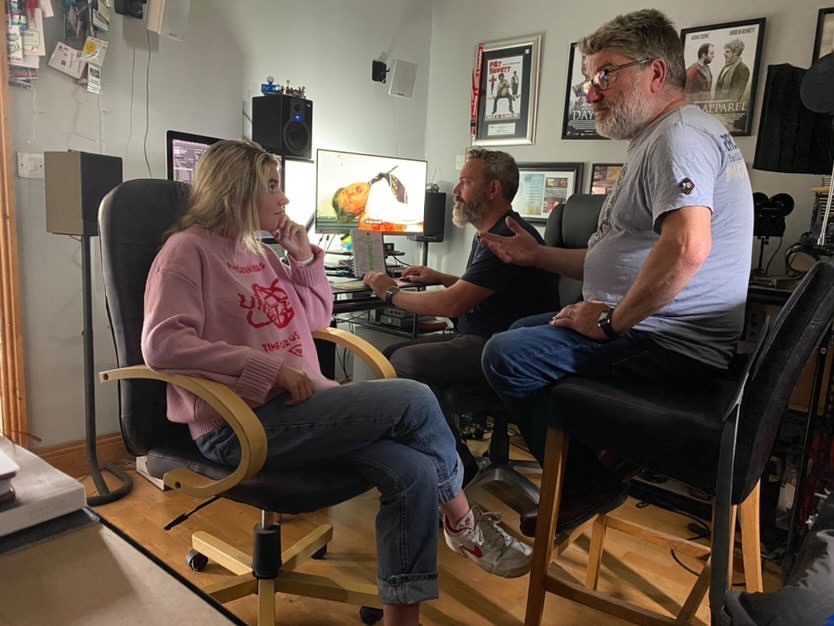
Faye & Pat Shortt discussing the edit with Simon recently. Finishing touches to Pat Shortt’s Comedy Heads.
With over 14,000 students on six campuses in Ireland’s Midwest and Midlands, TUS is Ireland’s newest and most unique Technological University. Through applied learning and fresh thinking, our focus is on meeting the evolving needs of society and industry, within our region and beyond.
The Creative Technologies Programmes, Creative Broadcast & Film Production, and Music Technology & Production, are looking forward to working with our new setup at the Moylish Campus. As part of the Department of Digital Arts & Media at Limerick School of Art & Design (LSAD) we offer creative opportunities to new students who are think of taking on the industries of Film, Television, Music and other creative areas.
For more information on the programmes at TUS check out the link below as well as the Open Days coming soon in Oct/Nov 2021:
Filming began on a new comedy project last week, involving the team from the Dublin Comedy Improv. This will be available online in the Autumn and features numerous sketches from a number of famous Irish comedy faces.
Production takes place on location in Counties Kildare and Limerick over the summer with post production to be completed early Autumn.
It’s that time of the year again when CAO applicants have the change to amend their choices for college places. If you need to amend or add courses you can use the Change of Mind facility before the 1st July at 17:15.
Based in the Moylish Campus, in Limerick, the Creative Broadcast & Film Production and Music Technology & Production Programmes offer a blend of learning solutions for those thinking of a career in the creative industries. As part of the Department of Digital Arts & Media, Limerick School of Art and Design, students have availed of the practice based programmes and achieved multiple awards both locally and nationally.
For more information, check out the programmes and the CAO change of Mind page on the links below.
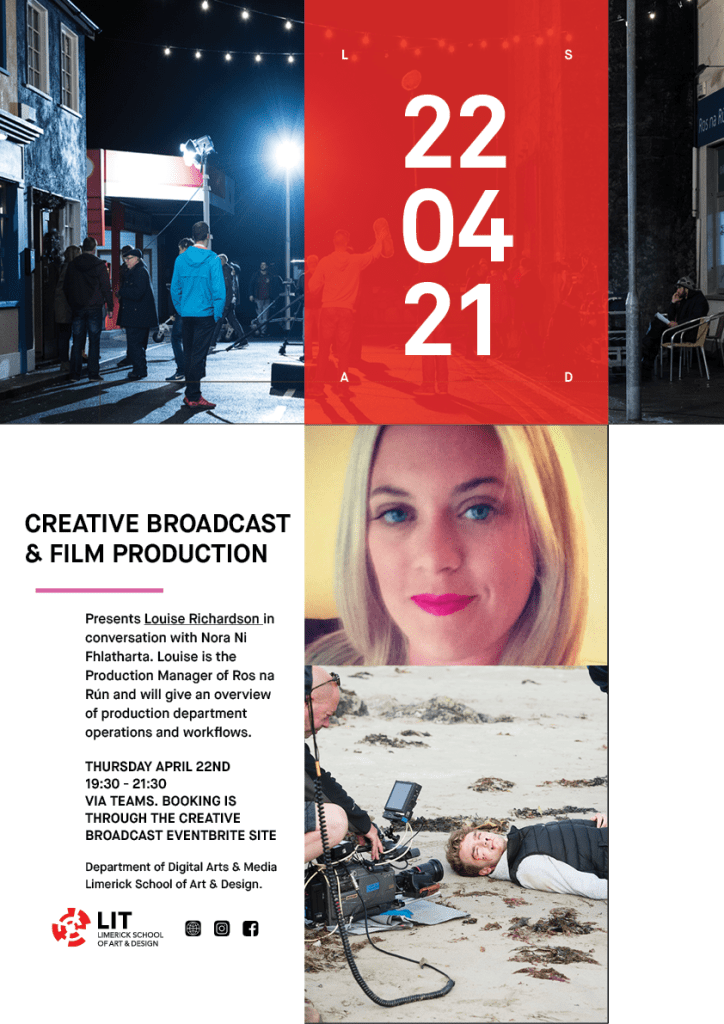
The next industry focus session from the Creative Broadcast & Film Production Programme at LSAD is with Louise Richardson. Louise is the production manager of Ros na Rún
About Ros Na Rún
Ros na Rún is a soap opera set in the fictional village of Ros na Rún, focusing on the domestic and professional lives of its residents. The only soap in the world which is produced in the Irish language (English subtitles available) Filmed in the heart of the Connemara Gaeltacht in Galway on the Wild Atlantic Way, it is the single largest independent production commissioned in the history of Irish broadcasting and currently the most concentrated production centre outside of Dublin and Wicklow.During this session, Louise will offer an overview of her role as a production manager, the various production department workflows and operating systems, and offer advice to new entrants in preparation for employment.
We hope to see you all there. Please take some time to learn a little about the company and be sure to catch up on the latest episodes available on the TG4 player.
Booking is via our eventbrite site. For students of Creative Broadcast & Screen Production Dept Skills there is no need to book as you have already been invited via teams.
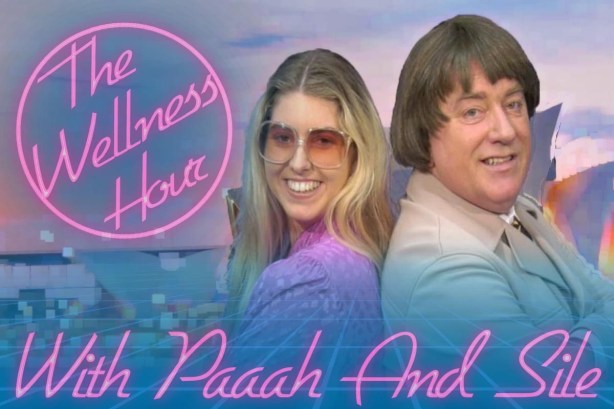
Back due to popular demand and for one night only on Sat 20th Feb is The Wellness Hour with Paaah & Sile Show! Tickets are now available on http://patshortt.com! Many thanks to the @DeptCulturelRL for their support for this production.
I was delighted to be the camera operator and editor on this exciting and very funny production with Pat and his daughter Faye Shortt. This is well worth a watch.
Pat Shortt the renowned Irish comedian brings his number one comedy show podcast”The Wellness Hour with Paaaah ” to the screens! Now co-starring reporter Sile, Faye Shortt, this is pure family entertainment at it’s best.
When the show’s about to start, the link to join will appear on your ticket, or you can access the stream link that we’ll email you on the day.
Dr.Fintan O’Brien, from the podcast, ‘The Wellness Hour with Paaaah’, graced our screens on June 26th 8pm RTÉ One for RTÉ Does Comic Relief. Pat Shortt has brought one of the favourite characters of the podcast to the small screen with hilarious results. The sketch also features a new character, Sile DeBurca Ní Cormicain played by Pat’s daughter Faye Shortt.
This sketch was filmed on location in Co. Limerick.
If you want to hear more of Dr. Fintan and other characters check out series one of the podcast Here
The first semester of having to teach online is over. It was a unique experience both for faculty as well as students. Some were able to handle it fairly well; we are a profession of technically adept filmmakers, after all.
But with the high probability of the Fall 2020 semester also being primarily online, and maybe even the following Spring 2021 (depends on when we see pharmacologic solutions), many students are having second thoughts about continuing their education. They are thinking, “Is it worth it? Maybe this is the time to take a semester or two off?”
Initially, the thought of taking a long sabbatical makes sense. Learning online is not the most effective means to learn filmmaking. After all, the production of films involves a lot of hands-on and close social activity. Only the act of scriptwriting is a solitary vocation.
However, as much as most of us Production Faculty want to reassure ourselves that the hands-on components of what we teach is state-of-the-art and irreplaceable – the realistic fact is that we only cover the tip of the iceberg.
Most of what we teach involves mindset and understanding the basic principles of our technical crafts (cinematography, editing, audio, etc.). It is not so much about the specific equipment, but what to do with said equipment in order to communicate.
This semester made me realize that most of what I had to share with my students was an understanding of how and why we do what we do on the set. I recalled the first thing that I concluded after leaving college with a freshly printed diploma and transcript. Working with seasoned professionals in Hollywood taught me more (technically) in several weeks than I had learned over four years on campus! The equipment and technology were way beyond the amateur levels provided by our film department.
However, my overall understanding of aesthetics and production flow was equal, if not sometimes superior to that of the veteran crew around me. So, my education was successful in terms of teaching me the big picture. I knew the principles of lighting, just not the nicknames of all the Mole-Richardson lights nor how to thread up a 35mm ARRI. I understood what was necessary to record on set, just not how to operate the fancy mixing panels and other gear.
The point that I am making is that most of what you will ultimately derive from a college degree in film/video/media does not rely solely on hands-on experience. It comes from learning the underlying thought processes, goals, and mindset of a professional. It goes hand in hand with learning the fundamental concepts of filmmaking, including the aesthetics, art, and business aspects.
It is about being pointed in the right direction, so that you know what you need to continue mastering on your own. What instructional videos to watch on the internet, what software is essential, and the industry standards. Seminars and workshops sponsored by guilds and manufacturers. User groups.
Practical Considerations Against Postponing College
By continuing to attend online, you keep your mind sharp and progress through your degree program. Sure, you will miss out a lot of the hands-on experience, but as I have learned in my many years of life on this planet: most of the hands-on training that you get at the majority of even the elite film programs does not equate to the levels that we operate at in the industry.
Your degree in film is not respected for what a college may or may not prepare you for in terms of hardware proficiency. That is a skillset that you can rapidly acquire with but a few weeks of workshops and seminars. On your own, or through post-curricular events sponsored by your college department.
For example, the department in which I teach has had numerous discussions regarding conducting special sessions as soon as it is deemed safe to do so, with many instructors even volunteering their own time and resources to make these happen. (When you leave Hollywood in order to teach, it certainly is not for the money!)
As a student, keep in mind that many of your classes are outside of the production realm. Writers learn much from understanding psychology, sociology, and history. Producers and freelancers should master accounting, contract law, and other business-related subjects.
If you do decide to take time off, what do you plan on doing with it?
Internships, during a pandemic, are scarce – and rarely involve any hands-on due to social distancing.
Earn money while you are no longer in college? Doing what? The economy is barely hiring right now, unless you want to be a delivery driver. Retail establishments are more concerned about hiring back some of the people that they had to lay off. There is no great rush to bring in a bunch of high school grads (who did not complete college yet) and offer them enticing positions.
But let’s pretend that money is not the issue. You could travel the world and experience a diversity of cultures. Or maybe not, on account of this virus thing.
Having spent six months or a year sitting around in a mask and bored like hell – you decide that you are ready to return to campus…
Although the colleges may be eager for you to re-enroll, they cannot guarantee your spot in the film program. Your original “class” of film students has progressed in their academic hierarchy and are now in the more advanced courses of the curriculum. You can no longer team up with your old friends on projects.
You now have to compete, not only with all of the new students entering (or progressing) in your program, but also with all of the returning “time off-ers”.
COVID-19 has forced budget cuts at all of the colleges. Courses may not have been cut, but it is unlikely that the number of courses/sections will be increased. Departments have limited production equipment, edit bays, computer labs, screening rooms, soundstages, control rooms, large classrooms, and other physical facilities.
So even if the academic administrators approved opening up additional sections of some courses and were willing to pay the instructors, there still may not be enough resources to support that many new students in the program.
Learn what you can, while you can
Going back to college after months away can be particularly challenging from a mental standpoint. Think about how hard it is to get back into an academic routine after just a summer break!
It will be even harder after a semester or two away!
And the film industry will not welcome you without a college degree. But they will not be as concerned about your lack of hands-on set experience compared to what they may think of your lack of a focused college degree in the field.
Trust me. Once things settle down in terms of the virus, there will be lots of opportunities to get up to speed with the latest gadgets. Even with 40 years professional experience and a holder of three degrees in filmmaking (B.A., M.A., Ph.D. ), I still have to strive to keep up with all of the technological advancements raining down on our industry every year. Workshops and seminars abound.
But that decision to postpone the completion of your college degree could cost you dearly. A year of “life experience” will not equate too much in the way of practical experience. But it could easily cost you your spot in an elite film program.
Is it really worth losing a year, just because you may not get as much hands-on production experience as you will in the first few weeks after you graduate?
Fred Ginsburg, CAS, Ph.D., is a highly experienced and award winning professional sound mixer whose decades of work includes features, episodic TV series, national TV commercials, corporate, and government. He is a member of the Cinema Audio Society and the University Film & Video Association. Fred holds doctorate, graduate, and undergraduate degrees in filmmaking; has published more than 200 technical articles along with a textbook, instruction manuals, and hosts an educational website. Fred instructs location recording and post-production sound at Calif State University Northridge
On the back of this very well composed article and if you are trying to decide on the Change of Mind CAO option, then please check out the Creative Technologies Programmes at LSAD.